The Spectre of Bismarck
By the summer of 1941, Europe was under the control of Germany and her allies, leaving Great Britain heavily reliant on convoys bringing supplies across the Atlantic from the United States. These convoys were the obvious strategic weakpoint of the British war machine. If enough of these convoy ships could be sunk for a sustained period, Britain would starve, and be forced to seek peace terms.
The German battleship Bismarck was one of the most powerful battleships in the Atlantic theatre in 1941. The match for any single ship in service on the sea, she displaced over 50,000 tonnes fully loaded and was 823.5ft long. Together with her sister ship, the Tirpitz, she represented the ultimate symbol of German naval might. She had the potential to force substantial changes to shipping routes and protection duties for the Royal Navy escorts. The convoys were already losing up to 500,000 tonnes of shipping a month to U-boats, and Bismarck’s presence in the Atlantic had the potential to strike at Britain’s lifeline at a pivotal moment in the war.
Originally, Bismarck’s first sortie, Operation Rhine Exercise, was planned to include Bismarck, the heavy cruiser Prinz Eugen, and the powerful battlecruisers Scharnhorst and Gneisenau. The two battlecruisers were detained in Brest for repairs, leaving Bismarck with only Prinz Eugen as escort. We can only speculate how this may have affected what was to unfold.
The Battle of the Denmark Strait
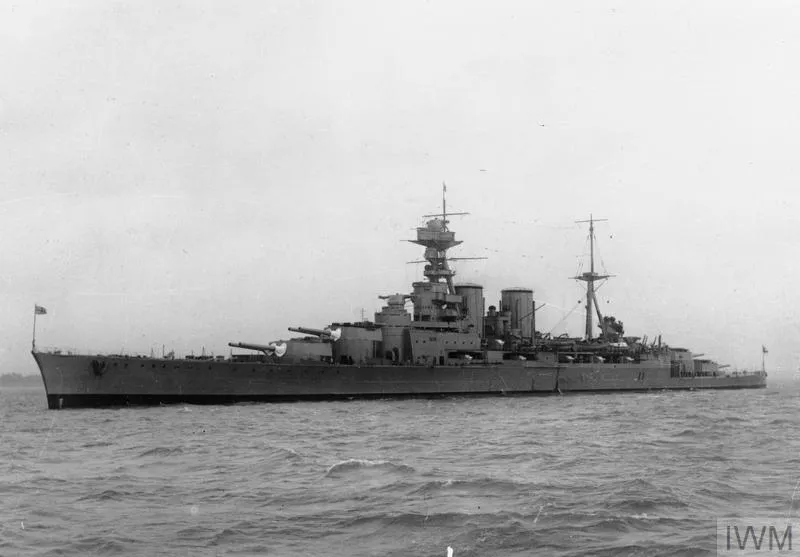
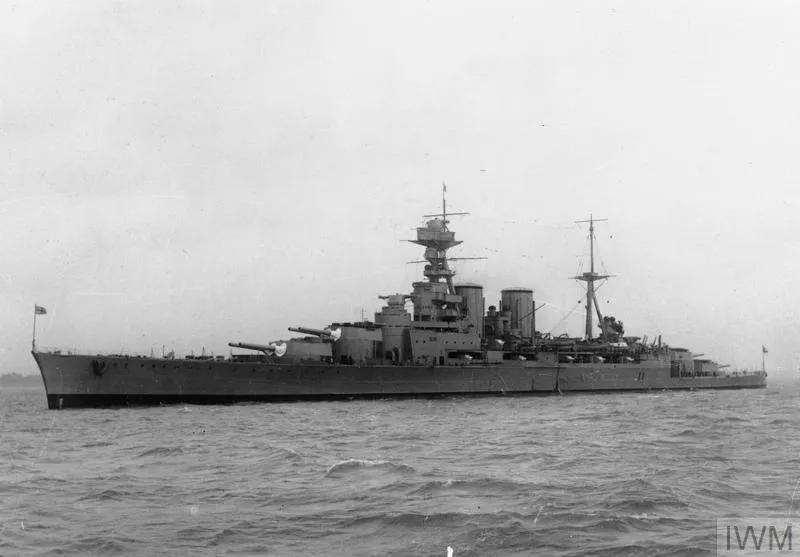
HMS Hood underway
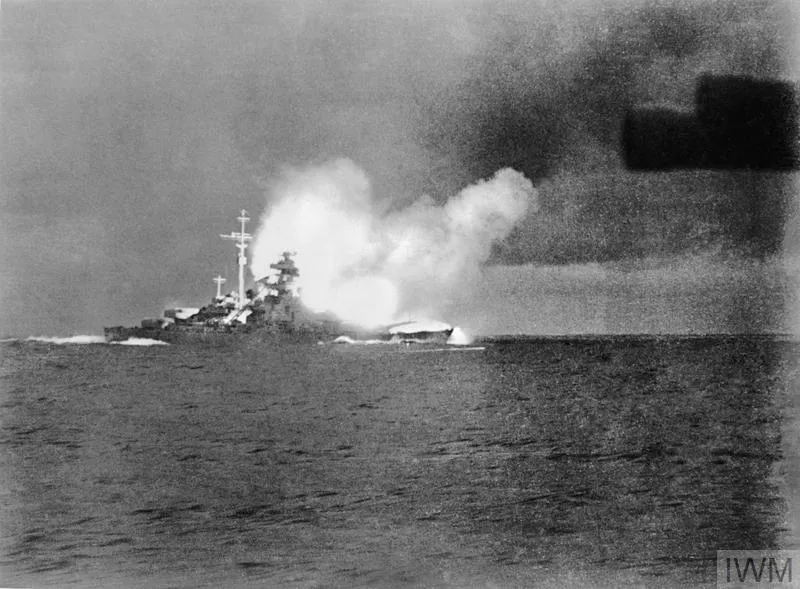
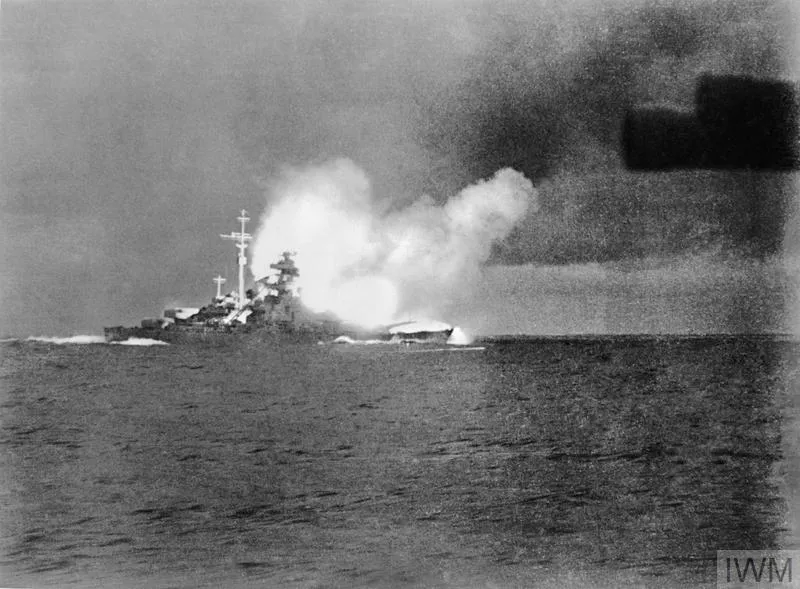
Bismarck firing on HMS Hood
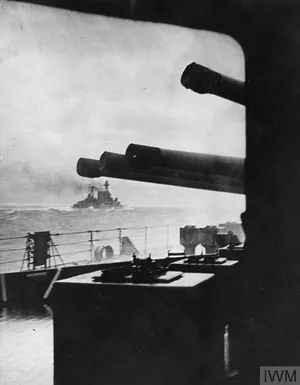
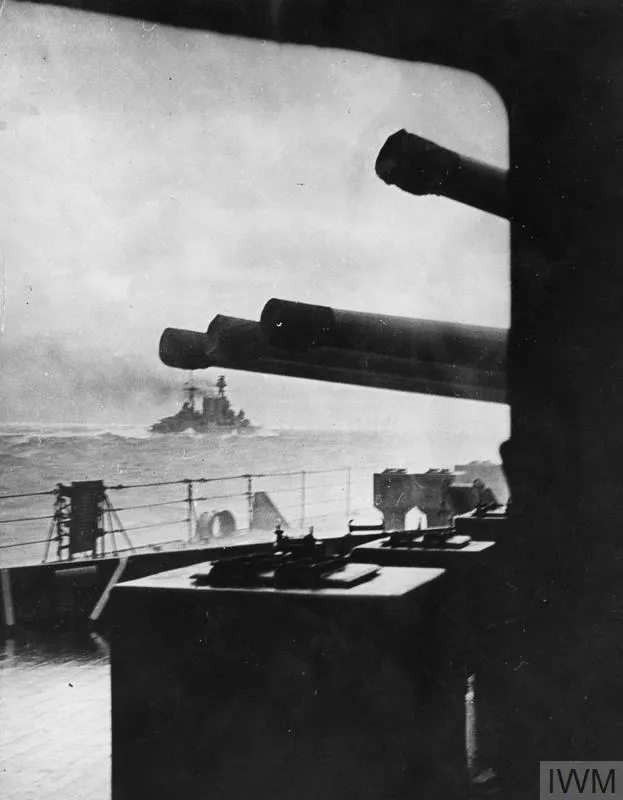
The last photograph taken of HMS Hood as she goes into action against Bismarck
Accompanied by her escort, the heavy cruiser Prinz Eugen, Germany’s brand new flagship Bismarck engaged Britain’s ageing flagship HMS Hood and the far more modern HMS Prince of Wales in the Denmark Strait, the waters between Iceland and Greenland. Iceland had been in union with Denmark until 1940, hence the strait’s name.
For twenty years, HMS Hood had been the mightiest ship afloat. Within ten minutes of Bismarck opening fire, Hood had exploded. Of her complement of more than 1,400 men, only 3 survived. Damaged themselves, HMS Prince of Wales and Bismarck withdrew. HMS Hood, the Pride of the Royal Navy, was lost.
Propaganda & German Hubris
A propaganda defeat of this magnitude could not stand. Bismarck and Prinz Eugen also still represented the enormous threat to merchant shipping in the Atlantic. Whilst the Royal Navy itself was vastly superior to the Kriegsmarine in both numbers and knowhow, the two ships could sink enough allied merchant shipping in a short time to bring Britain’s war effort to its knees. Bismarck had to be sunk, and quickly.
Owing to the hubris of the German fleet planners, Bismarck (and her sister Tirpitz) had only one option for repairs without heading all the way home to Germany—the ports of north-western France, now under German control. Britain knew this, and located Bismarck heading from its battle with HMS Hood and HMS Prince Of Wales straight to France. Now to sink the largest battleship in the Atlantic.
HMS Prince Of Wales
.BzuHo7k__2hqMRG.webp)
.BzuHo7k__jyFf.webp)
HMS Prince of Wales later in the war
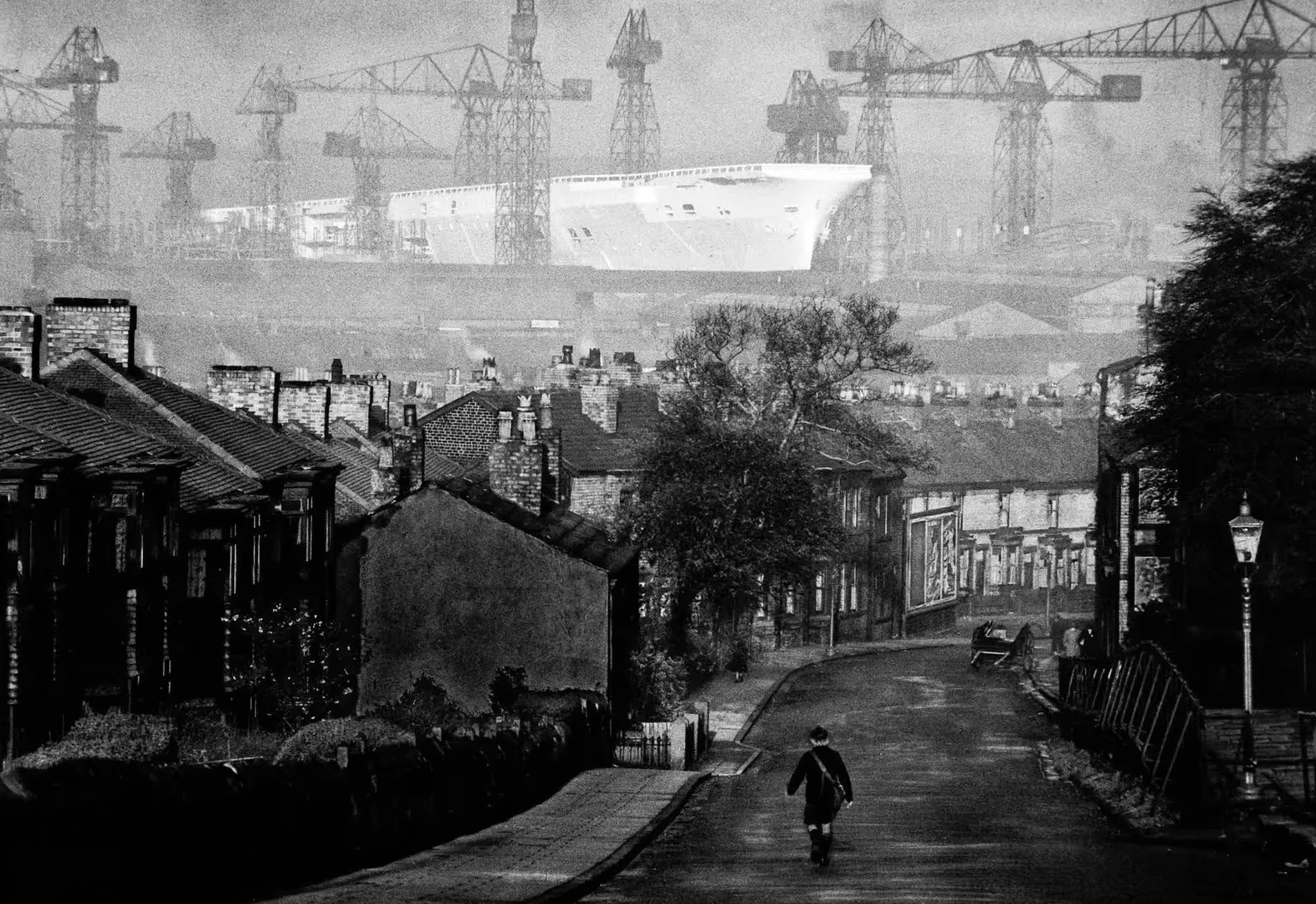
HMS Hood’s escort during the Battle of the Denmark Strait was HMS Prince Of Wales. She was built in Cammell Laird’s shipyard in Birkenhead on the banks of the Mersey, and commissioned in 1941. She was a King George V-class battleship, one of five in the class which formed the backbone of the Royal Navy’s modern battleship fleet commissioned between 1940 and 1942. They were new ships, but their design process had been protracted and complicated by the Washington Treaty, an interwar effort to limit the size and strength of battleships and avoid the sort of arms race which had preceded the First World War.
The Washington Treaty contained an escalator clause, which allowed navies to build larger ships with larger guns than stipulated in the event that one major power broke the terms of the treaty or opted to withdraw from it. In 1938, Imperial Japan did exactly that when it refused to sign an updated form of the treaty, and the escalator clause was triggered for the remaining signatories.
These events came too late for Britain to redesign the King George V-class, and they were arguably built slightly underpowered as a result. Most notably, they had 14” main guns compared to the 15” guns on the latest German, French and Italian ships, 16” guns on the latest United States’ vessels, and gargantuan 18” guns on the Japanese Yamato-class. Calibre is by no means everything with these guns, and the British gun design was both powerful and tried and tested, but there is no doubt the King George V-class battleships had smaller armament than the Royal Navy might have otherwise chosen.
Under extremely strict secrecy Japan had already begun construction of the Yamato, Musashi, and Shinano (converted to a carrier before she was completed) before refusing to sign the 1938 amended treaty. These Japanese vessels were the largest battleships ever built.
Germany was not a signatory to the Washington treaty, but it did have a bilateral agreement with Great Britain to limit its navy. The Nazis simply chose to violate that agreement and construct the massive Bismarck and Tirpitz with 15” guns.
.xAHKC184_1vWmF5.webp)
.xAHKC184_Z12su0L.webp)
British Prime Minister Winston Churchill aboard HMS Prince of Wales. The ship's massive quadruple aft turret is behind.
It’s easy to oversimplify these vessels and compare their size and armaments, but there are many factors which make a battleship great or not. The British ships had superb armour protection, superior radar and fire control, and were manned by more experienced crew than their German counterparts. Despite the smaller calibre of the main guns, their shells were more destructive, and the ships had ten guns to Bismarck’s eight, meaning a full broadside was heavier than Bismarck’s. Crucially, Britain also had five ships of this class, and a further two ships of similar calibre in the sisters HMS Nelson and HMS Rodney. We will meet the latter ship—another Cammell Laird-built vessel—later in our story.
HMS Prince of Wales played a vital role in the ultimate destruction of Bismarck by inflicting enough damage on the German ship that she had little choice but to put in for repairs at a destination known to British intelligence. The damage also left a trail of oil leaking from the vessel, which allowed her to be tracked early in the pursuit. Strike One for Birkenhead!
HMS Ark Royal
.BYivcQCi_2mLvna.webp)
.BYivcQCi_YtHMA.webp)
HMS Ark Royal under attack later in the war
In the interwar years, aircraft technology made spectacular progress, and the benefits of taking these machines to sea had become clear. Navies experimented with converted warships, putting flight decks on top of old hulls to make early aircraft carriers. Eventually, purpose-built carriers were designed.
HMS Ark Royal was one of these, and whilst not the first, she set the blueprint for carrier design as we know it. She had a double-deck hangar and her flight deck formed a rigid structural asset to the vessel, part of her very hull rather than mere superstructure. Unlike subsequent British carriers, HMS Ark Royal did not have an armoured flight deck.
.K9KamXxL_1uQpIv.webp)
.K9KamXxL_Z1UUL1Q.webp)
A Fairey Swordfish returning from an attack on Bismarck
HMS Ark Royal was critical in the successful hunt of the Bismarck. On 26th May 1941, it was a Swordfish aircraft from HMS Ark Royal which located the Bismarck. The German ship was too fast to be caught before she would reach France, and she had to be slowed down. Fifteen further Swordfish planes were loaded with torpedoes and sent after Bismarck. They succeeded, and left Bismarck with damage to her engine rooms and starboard rudder, locking the ship in a 15-degree turn to port. This gave the pursuing fleet the time they needed to catch up.
HMS Rodney
.B9C6GUXn_1GsrQb.webp)
.B9C6GUXn_1FyQBq.webp)
HMS Rodney with her unusual turret layout
The final battle. HMS Ark Royal’s planes had slowed Bismarck down, and now it was the job of the Royal Navy’s battleships to finish the pursuit. The task fell to HMS King George V and HMS Rodney.
HMS King George V was one of the modern ships described earlier and a sister of HMS Prince of Wales, but HMS Rodney was a very different beast. She was an extremely unusual design with three large turrets set ahead of her bridge, all firing forward. The design was a direct result of the Washington Treaty, evolving from some highly ambitious plans for truly enormous vessels which the Royal Navy had wanted to build following World War One. Apart from the treaty considerations, there was also a very real concern about size which again comes back to Liverpool—these earlier designs would build ships which could only be repaired in one dry dock in British control. That dock was the Gladstone Graving Dock in Liverpool. Having such limited options for below-the-waterline repairs was an obvious strategic weak point for any such vessel, and so the ships were made shorter. Along with other considerations, this led to the two striking triple-turreted vessels of the Nelson class that were commissioned between 1927 and 1929. The innovative design did allow the Admirality to fit the Nelson class with 16” guns, the largest calibre guns ever fitted to a a European battleship.
I believe it is instructive about the nature of the two regimes that when a compromise on size was preferable to strategic limitations, the British planners chose pragmatism, whereas the braggadocio of the Nazi planners left the Bismarck and Tirpitz with precisely the vulnerability that the British avoided by shortening the Nelson class. Not only was it a major factor in the loss of the Bismarck, but once the facilities in Saint-Nazaire were destroyed in an extraordinary action later in the war, Tirpitz was consigned to a Norwegian fjord, as using her was now impossible without the only repair facility outside Germany large enough for her.
By the time HMS Rodney faced the Bismarck in the Atlanic that day, she was no longer a cutting-edge ship. She had been diverted from her voyage to Boston where she had been due to undergo a major refit and modernisation.
Bismarck was bombarded for nearly two hours. In the final stages of the battle, with all of Bismarck’s guns out of action, HMS Rodney closed to within two miles—point blank range for such ships—and vengefully pulverised the Bismarck. During this attack, Rodney became the first and only battleship to fire a torpedo at another battleship.
.DheSW3Mi_ajHbQ.webp)
.DheSW3Mi_1wePC8.webp)
Survivors of the Bismarck are rescued by HMS Dorsetshire
The loss of HMS Hood was a human catastrophe and the anger felt by Royal Navy sailors was understandable, but it should not be forgotten that many of the sailors aboard the Bismarck were ordinary German men caught in a conflict larger than them. Of Bismarck’s crew of more than 2,200, at most 116 survived.
The immediate threat to Allied merchant shipping was temporarily averted.
Birkenhead had sunk the Bismarck.
Image Credits
1. Image: IWM (FL 776) HMS Hood underway ↩
2. Image: IWM (HU 381) Bismarck firing ↩
3. Image: IWM (HU 50190) HMS Hood last photo↩
4. Image: IWM (A 6784) HMS Prince of Wales ↩
5. Image: IWM (H 12784) Churchill aboard HMS Prince of Wales ↩
6. Image: IWM (A 2298) HMS Ark Royal under attack ↩
7. Image: IWM (A 4100) Fairey Swordfish ↩
8. Image: IWM (A 9605) HMS Rodney ↩
9. Image: IWM (ZZZ 3130C) Bismarck survivors↩