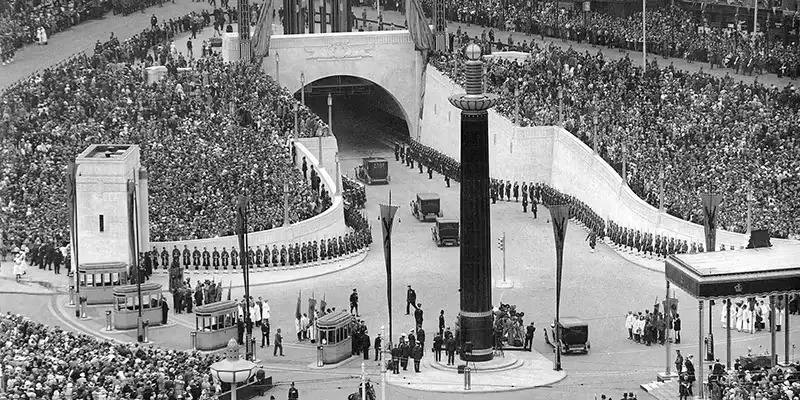
The first scheduled intercity railway service on Earth began its maiden service on 15th September 1830 with great fanfare. The Prime Minster and former Liverpool MP, The Duke of Wellington, was guest of honour, and crowds gathered to watch the the grand opening of the Liverpool to Manchester Railway at Edge Hill.
The trains would leave Edge Hill and head towards Liverpool Road Station in Manchester, with a stop at Parkside (just east of Newton-le-Willows) roughly half way through the journey. Unlike some earlier railways, this was entirely run by steam engine, with double tracks and signalling.
The trains were slow by our standards, but exhilaratingly rapid for the people of the day whose greatest sensation of speed had been riding a horse. The incredible power and almost magical ability to produce it also left a deep impression on many. Twenty-one-year-old actress Fanny Kemble was given a preview ride on the legendary Rocket locomotive a few weeks before the famous opening, and described the experience in her memoirs with a delightful novelty:
You can’t imagine how strange it seemed to be journeying on thus, without any visible cause of progress other than the magical machine, with its flying white breath and rhythmical, unvarying pace. The carriage … was set off at its utmost speed, thirty-five miles an hour, swifter than a bird flies (for they tried the experiment with a snipe). You cannot conceive what that sensation of cutting the air was; the motion is as smooth as possible, too. I could either have read or written; and as it was, I stood up, and with my bonnet off “drank the air before me.” The wind, which was strong, or perhaps the force of our own thrusting against it, absolutely weighed my eyelids down. When I closed my eyes this sensation of flying was quite delightful, and strange beyond description; yet, strange as it was, I had a perfect sense of security, and not the slightest fear.
- Fanny Kemble in her memoirs.
The Trains
On that opening day, a special train was laid on for guests of honour, including foreign ambassadors, MPs, and the Prime Minister Lord Wellington. It consisted of three specially-constructed carriages pulled by the locomotive Northumbrian and driven by George Stephenson himself.
The middle carriage was more of a pavilion on wheels, extending two feet proud of the wheelbase on each side, walled by an ornate sold guardrail. The covered central part of the carriage was covered by a roof topped by two ducal coronets. The pillars that held the roof up had curtains attached which could be drawn in the event of inclement weather. Beyond this area at each end were two uncovered balconies of sorts. All this was an eye-catching crimson colour with gold inlays, giving an impression of a theatre box put on wheels.
This carriage was twice the usual length, necessitating two bogies so it could make use of eight wheels rather than four, the mechanics of which elevated this carriage a little above the normal height. The door was a gate in centre of the guardrail which swung outwards, and attendants would then bring a set of steps for embarking and disembarking. Tragically, this unusual design would lead to one of the most famous early rail tragedies.
Along with the special train, another train ran on the other track, heading in the same direction as the VIP one. It ran a little behind and carried less distinguished guests. This was pulled by the famous Rocket locomotive.
The Accident
The serving MP for Liverpool, William Huskisson, was one of the special guests riding in one of the two carriages straddling Wellington’s. Two years prior the two men had fallen out as Huskisson left the cabinet under a cloud, so despite some ill-health Huskisson was determined to take the opportunity to repair the relationship.
When the ceremonial train came to a stop at Parkside, Huskisson alighted onto the track against the instructions of his hosts, and made his way along the train. Lord Wellington saw the man and leaned over the guardrail of his carriage and shook Huskisson’s hand. This must have been a stretch given the height of the carriage.
At that moment, a cry went out warning that the second train was arriving on the track occupied by Huskisson, and he had to make a decision quickly about what to do. He could back away from the train across the second track to safety, attempt to stay in the gap between the trains, which was not generous given the unusually wide design of the ceremonial carriage, or he could attempt to climb onto the Duke of Wellington’s carriage. Tragically, in his panic he chose the last option.
He was a famously clumsy man and sixty years of age, but perhaps that is overplayed as a reason for his demise. He grabbed the handrail of the carriage where he stood in order to pull himself up and over it. Sadly, this was the very part of the handrail that formed the gate, and it was not secured. When he pulled his weight up, the gate swung open and Huskisson fell onto the empty track, just at the moment the Rocket arrived and ran over his leg, mangling it horribly.
The Northumbrian was quickly detached from its train and Huskisson was rushed to Eccles on it, but in vain. He died from him injuries that evening. Today, Parkside Station is long gone, but there is a fairly grand memorial to the tragedy right by the tracks where it took place just east of Newton-le-Willows, which is passed by modern trains with most passengers none the wiser. Huskisson also has an elaborate memotial in St James’ Cemetary in the shadow of the Anglican Cathedral.
Whilst not the first casualty of the railway, he was certainly one of the most well-known and reported. A Member of Parliament and former cabinet minister losing his life on the opening day of the railway led to worldwide press coverage, spreading knowledge of his new form of transportation–and its dangers–far and wide.
Legacy
This railway set the precedent for scheduled railways all over the world, and they changed it in more ways than meets the eyes. Before trains that could move at tens of miles per hour, there was no need for each town to stick to a standardised timezone, and so the clocks in Bristol would read eleven minutes behind than those in London, and nobody knew or cared. After railways, there was quickly a need to sync up the nation’s timekeeping, and Greenwich Mean Time was adopted by the railways in 1847. Literally, this is the average, or mean, time of the actual solar times in the UK time zone.